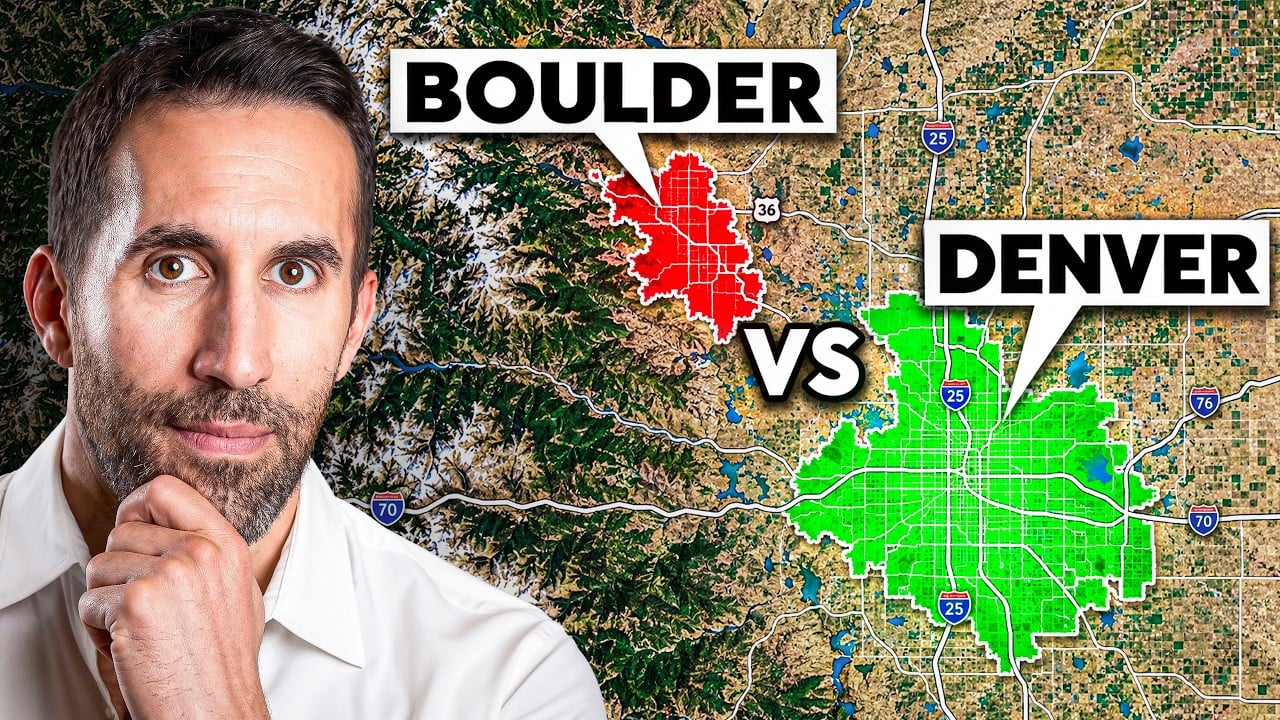
Denver and Boulder sit close together, but they feel like different planets, and a single-family home in Boulder can cost roughly double. Ross Blahnik, a Realtor with Oak Group Colorado, breaks down why and who each city fits best. Market figures reflect his video at the time of recording and will change.
Denver vs. Boulder at a Glance
Denver is the state capital and the most central, busiest place in Colorado. Your neighborhood shapes your life here: LoDo for brick warehouses turned restaurants and rooftop bars, RiNo for murals and breweries, Washington Park for tree-lined blocks and bungalows, and Cherry Creek for shopping and dining. Prices can differ a lot from one neighborhood to the next.
Boulder sits off on its own against the foothills, a college town with close to 39,000 students at the University of Colorado Boulder. Locals joke about the “Boulder bubble.” Spend a morning on Pearl Street with the Flatirons rising behind the buildings, and you’ll get the picture.
The Price Gap
A single-family home in the city of Boulder runs about $1.5 million. In Denver overall, it’s the mid-to-high $600s.
The exact figure depends on who’s counting. Include condos and townhomes, and Boulder’s typical price eases toward the $900s. County-wide numbers in the mid-to-high $700s look lower only because they include Longmont, Lafayette, and Louisville, where prices sit well below the city of Boulder.
Why Boulder Is So Expensive
Limited Supply
Boulder planned its limits decades ago:
- Open space: In 1967, Boulder became the first city in the country to tax itself specifically to buy open space. Roughly 46,000 acres are now protected.
- Height caps: Nothing rises up to block the view of the Flatirons.
- A water line: Above a line drawn up the mountainside, Boulder won’t run city water.
The permit numbers show the effect. In the first stretch of the year covered in the video, Boulder approved barely a hundred new homes, while Denver approved a few thousand, about 30 times as many. Denver is mostly adding apartments, and most new detached homes have gone to Douglas County.
A Tech and Science Economy
Boulder’s job base includes Google’s downtown campuses, federal labs like NIST, NOAA, and NCAR, and aerospace and defense employers like BAE Systems and Lockheed Martin. Its concentration of tech jobs runs four to five times the national average. Ross calls it the “Bay Area of the Rockies.”
Denver isn’t far behind on jobs. Its economy is more diversified, and it ranks near the top among big metros for private aerospace jobs. Boulder concentrates the brainpower; Denver spreads it around.
Outdoor Access
In Boulder, the outdoors is a lunch break you can walk to. Chautauqua Park puts a trailhead inside the city with dozens of miles of trails. The catch is crowds: on summer weekends the lots can fill before breakfast, so plan around the Park-to-Park shuttle.
In Denver, the outdoors is an afternoon or weekend you drive to. The foothills and Red Rocks are a short drive west, and the big ski resorts are 90 minutes to two hours away. In town, you get Sloan’s Lake, Washington Park, City Park, and the Cherry Creek and High Line Canal trails.
The Trade-Offs
- Airport: Denver International is about half an hour from downtown Denver by car, or you can ride the A Line from Union Station. From Boulder, it’s closer to an hour, with no train. Advantage: Denver.
- Sports and entertainment: Denver has all four major-league teams plus one of the country’s largest performing arts complexes. Boulder has CU football at Folsom Field and more intimate local theaters.
- Day-to-day life: Denver is bigger, and the I-25 run from downtown to the Tech Center is the most congested stretch in the state. Boulder is small and self-contained, so you rarely leave the bubble.
Who Should Choose Which?
Boulder fits you if your weekends revolve around the outdoors, you love college-town energy, you want a tech-and-science circle, and your budget allows it. Boulder’s price of entry doesn’t bend.
Denver fits you if you want pro sports, big venues, and nightlife, and the freedom to match a home to your budget. It suits someone happy to drive 20 minutes to a trailhead rather than pay seven figures to walk to one.
As Ross puts it, Boulder makes you choose between your budget and everything else, while Denver lets you keep almost everything else and still find a budget that fits. Neither is wrong. They’re built for different lives.
Choose Your Zip Code on Purpose
Out here, your zip code is your lifestyle. Not sure which city is your fit? Email Ross Blahnik at [email protected] with your budget and must-haves. He’ll line both markets up against your number and send back a clear game plan.
Sources
- University of Colorado Boulder, Campus Info Card (enrollment)
- University of Colorado Boulder, The Coloradan: “Open Space” (1967 open space tax)
- Visit Boulder, Green Boulder (46,000 acres of open space)
- Elevations Credit Union, A Look Back at Boulder’s Open Space (water “blue line”)
- Visit Boulder, The Insider’s Guide to Chautauqua Park (trailhead and shuttle)
Check out this article next